
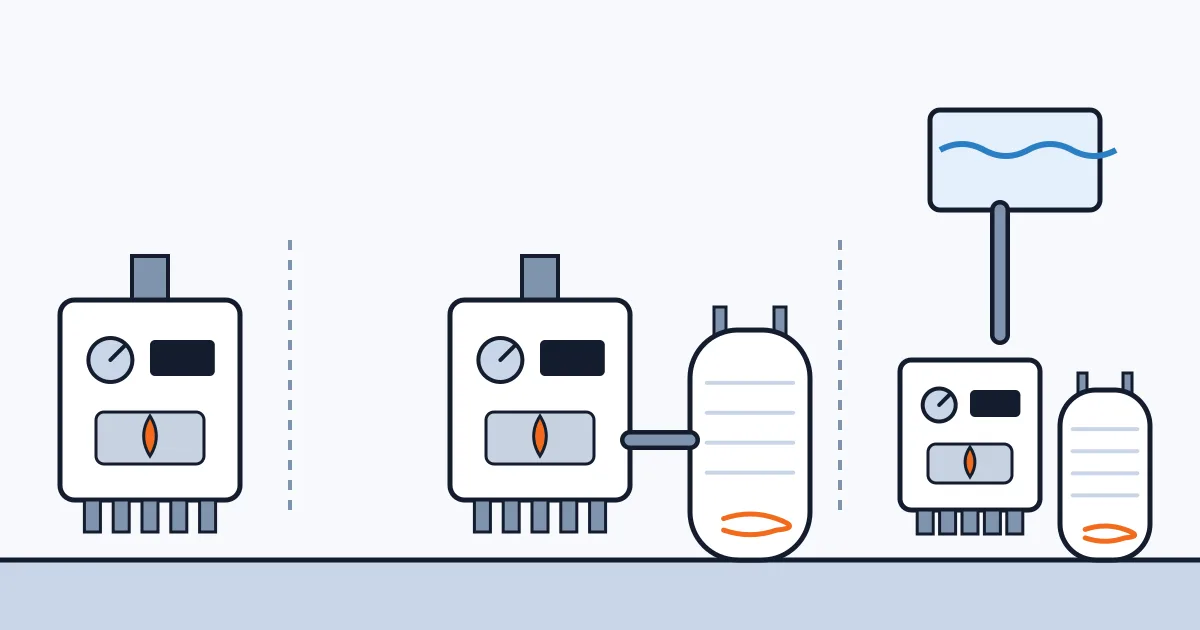
Gas boilers come in three main types, and the difference is how they deal with hot water. A combi heats it as you use it. A system boiler heats a cylinder you store it in. A regular boiler does the same but relies on tanks in the loft. Knowing which you have is the first step in pricing any change.
The three types
How the three boiler types compare
| Type | Hot water | What else it needs | Usually suits |
|---|---|---|---|
| Combi | Heated on demand from the mains | Nothing: no cylinder, no loft tanks | Smaller homes with one or two bathrooms |
| System | Stored in a cylinder | A hot water cylinder, usually indoors | Larger homes where several people need hot water at once |
| Regular | Stored in a cylinder | A cylinder plus feed and expansion tanks in the loft | Older houses with an existing tank set-up |
Combi boilers
A combi saves space because there's no cylinder and no loft tank. The catch is that it depends on your mains water supply, so weak pressure or lots of simultaneous use can leave it struggling. A combi boiler installation is often the cheapest option when you already have a combi, and costs more for a conversion. See our combi installation cost guide for the figures.
System and regular boilers
Both of these store hot water, so you get a good flow to several taps at once. A system boiler has the main parts built in and just needs a cylinder. A regular boiler is the traditional arrangement, with a tank in the loft that feeds the heating and another that tops up the cylinder. If you have a cylinder and a loft tank, you have a regular boiler.
How to tell which you have
- Look for a hot water cylinder, normally in an airing cupboard. If there isn't one, you probably have a combi.
- Look in the loft for a small tank. A tank there, plus a cylinder, points to a regular boiler.
- If there's a cylinder but no loft tank, you most likely have a system boiler.
- Check the label on the boiler or the manual for the model name, which usually says combi, system or regular.
- If you're still unsure, ask a Gas Safe registered engineer during a service visit.
Moving from a regular or system boiler to a combi means removing the cylinder and tanks, and it isn't right for every household. A swap in the same type is simpler. A gas boiler replacement usually keeps the existing set-up.
If you're fitting a boiler where there wasn't one, gas boiler installation covers the whole system. Whichever you choose, the right output matters too, and a guide on sizing is planned.
How to tell which type of gas boiler you have
- Look for a hot water cylinder
Check the airing cupboard for a tall cylinder. If there isn't one, you probably have a combi boiler.
- Check the loft for a tank
A small tank in the loft, together with a cylinder, points to a regular boiler.
- Identify a system boiler
A cylinder with no loft tank most likely means a system boiler.
- Read the boiler label
The model name on the boiler or in its manual usually says whether it is a combi, system or regular model.
- Ask an engineer if unsure
A Gas Safe registered engineer can confirm the type during any visit.
Frequently asked questions
What are the main types of gas boiler?
Combi, system and regular. They differ in how they supply hot water and whether they need a cylinder or loft tanks.
Is a combi boiler better than a system boiler?
Neither is better overall. A combi suits smaller homes with decent mains pressure, while a system boiler suits larger homes with several bathrooms.
Can I change from a regular boiler to a combi?
Often yes, if the mains supply can cope. It involves removing the cylinder and tanks and reworking the pipes, so ask for a survey.
Ready to talk to a gas boiler installation specialist?
Get Free Quotes →